
The Missing Intelligence in Leadership
Multiple intelligences are running the meeting - whether you know them or not.

Most leaders try to think their way out of tension. But the tension isn’t in the mind - it’s in the shoulders, the jaw, the shallow breath that says I should have this handled by now.
For centuries, Western culture has been shaped by Descartes’ declaration, “I think, therefore I am.” We’ve been so conditioned by this perspective that we’ve forgotten we are more than just minds on sticks. We’ve learned to ignore and override the signals we receive from our emotions and physical senses.
Having spent almost half my life in Silicon Valley, I've come to realize that this imbalanced obsession with cognitive intelligence is even more apparent. As one author describes the culture of the SF Bay Area: “People are dreaming up the future here, who have never fully experienced their own bodies or emotions.”
Yes, cognitive intelligence is vital - but your mindset can only take you as far as your body allows.
Somatic intelligence is one of the three primary forms of intelligence, alongside cognitive and emotional intelligence. It’s inward-facing, focused on your internal experience rather than the external world. Therefore, it is more fundamental than social or relational intelligence. Somatic intelligence refers to our capacity for sensing and acting. It’s the ability to discern what’s happening in our bodies. It’s being able to notice and observe a range of sensations. It’s also observing how sensation changes depending on the situation. Somatic sensations can point to where we are stuck and where we are holding on. They also provide insight into why we might feel or think certain things.
When you increase somatic intelligence, you deepen self-mastery.
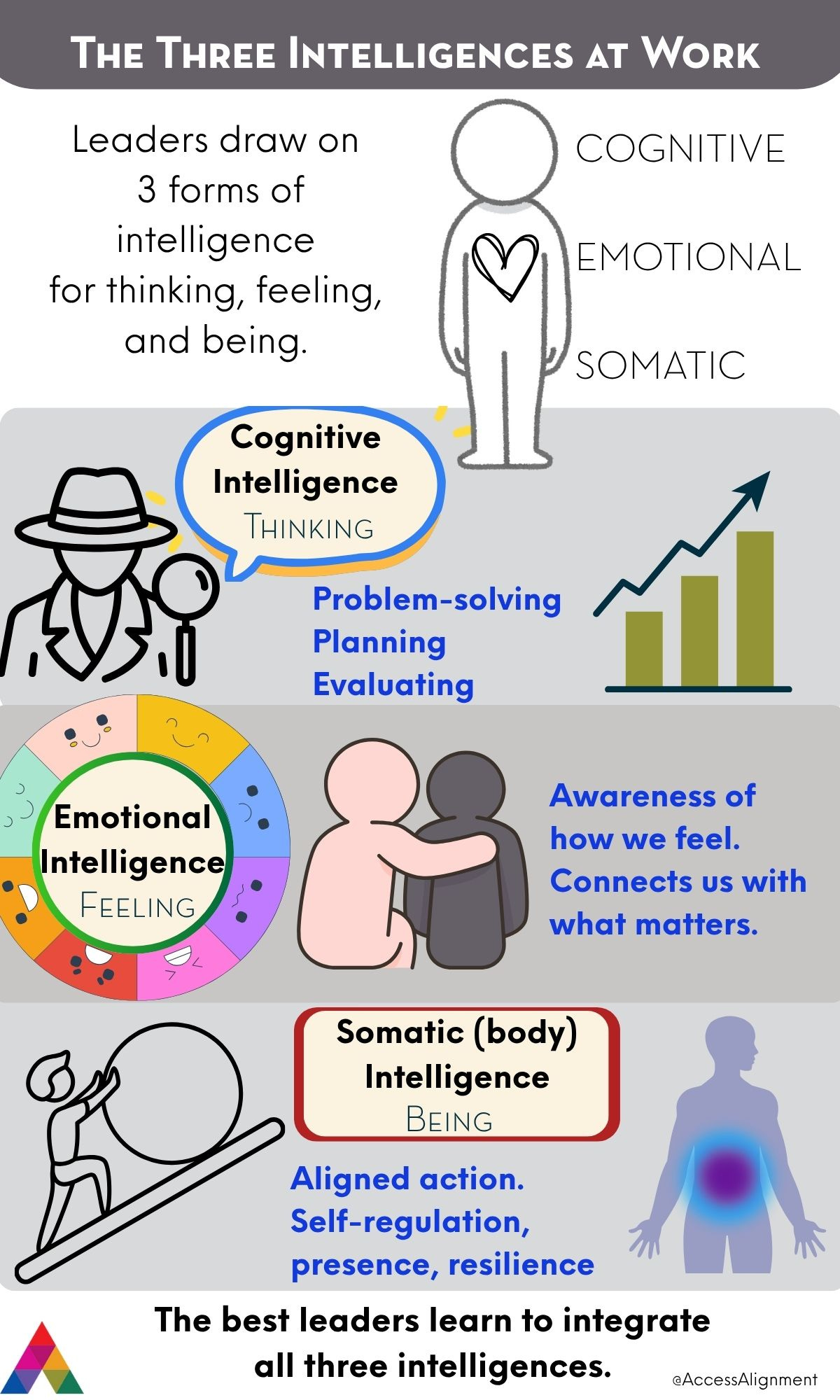
The Intelligence Beneath Thought
Our life’s adversity is woven into muscle, fascia, and tissue. Our history accrues like weight in the tissues. We are not free; we are encumbered.
Even when we process our emotions or thoughts – through therapy, reflection, or mindset work – it only takes us part of the way. The body can maintain a holding pattern.
And that’s the challenge. When we want to change our lives or our leadership, we fixate on mindset. But the body is the vessel that sustains those old habits. In my work as an executive coach, I’ve seen leaders make real change – yet without a somatic component, they find themselves circling back like a boomerang, and wondering why their old patterns repeat.
The body is our foundation, quietly maintaining old structures. Because it’s silent – and because we’ve forgotten how to listen – it’s often overlooked.
What the Body Knows About Leading Well
Leadership is hard – even when our bodies feel good.
While self-mastery isn’t required for leadership, it’s what distinguishes the exceptional from the merely competent.
Somatic intelligence – one of the three intelligences that underpin self-mastery – expands our capacity to be with complexity, nuance, and difficulty - because our leadership is embodied.
The tone you set for your team isn’t only about what you say or do; it’s how you do it. Leadership is evident in your posture, tone, the space you create, and the energy you exude.
When leaders ignore their bodies, they unconsciously repeat patterns that limit growth. They rush decisions when tense, grow defensive when overwhelmed, or pull back when fear tightens the chest. These aren’t just “bad habits”; they are somatic patterns.
Somatic intelligence teaches leaders to notice what’s happening in their bodies as data – early signals before burnout, reactivity, or conflict escalate. By learning to adjust posture, openness, or pace, we create new options for responding and build resilience – the capacity to recover and adapt.
Somatic awareness brings heightened presence and steadiness into high-stakes moments, enhancing your effectiveness and setting you apart.
While cultivating somatic intelligence won’t solve everything, it is often the simplest and fastest way to shift when you feel stuck. It’s also a great place to look when you’ve tried everything else and the same results keep repeating.
Performance Starts in the Body
No mat. No mantra. No meditation cushion required. You can start right now.
Pause and Reset: Relax your eyes, unclench your jaw, and take a deep inhale followed by a long, slow exhale. Repeat three times. Notice how your thoughts shift as your body does.
Release Tension: Make a tight fist for five seconds, then let it go. Squeeze your shoulders, then gently release them. Repeat. Feel the difference in your shoulders, chest, and mind.
Get Unstuck: When you’re stuck on a problem, stop trying to outthink it – get up, move around, or gently shake. Movement releases trapped energy – often, insight follows.
Align Your Spine: Before a meeting, place both feet on the floor. Feel your sit bones on the chair. Lengthen your spine. Lean slightly forward, then slightly back before settling into neutral. Notice how a subtle alignment shift (forward and back) changes your presence.
These small practices add up. Over time, they quietly rewire how you respond to stress, how you recover from challenge, and how you show up as a leader others actually trust.
Lasting change rarely comes from more information or another framework. It comes from letting go of patterns that no longer serve you and aligning head, heart, and body for impactful leadership.
Before you move on to your next task:
Which of these four practices was the most helpful to you?
Would it be worth weaving it into your daily rhythm – and if so, when?
Cheers to intelligent leadership,